15/05/19 Cara-cool Ruins

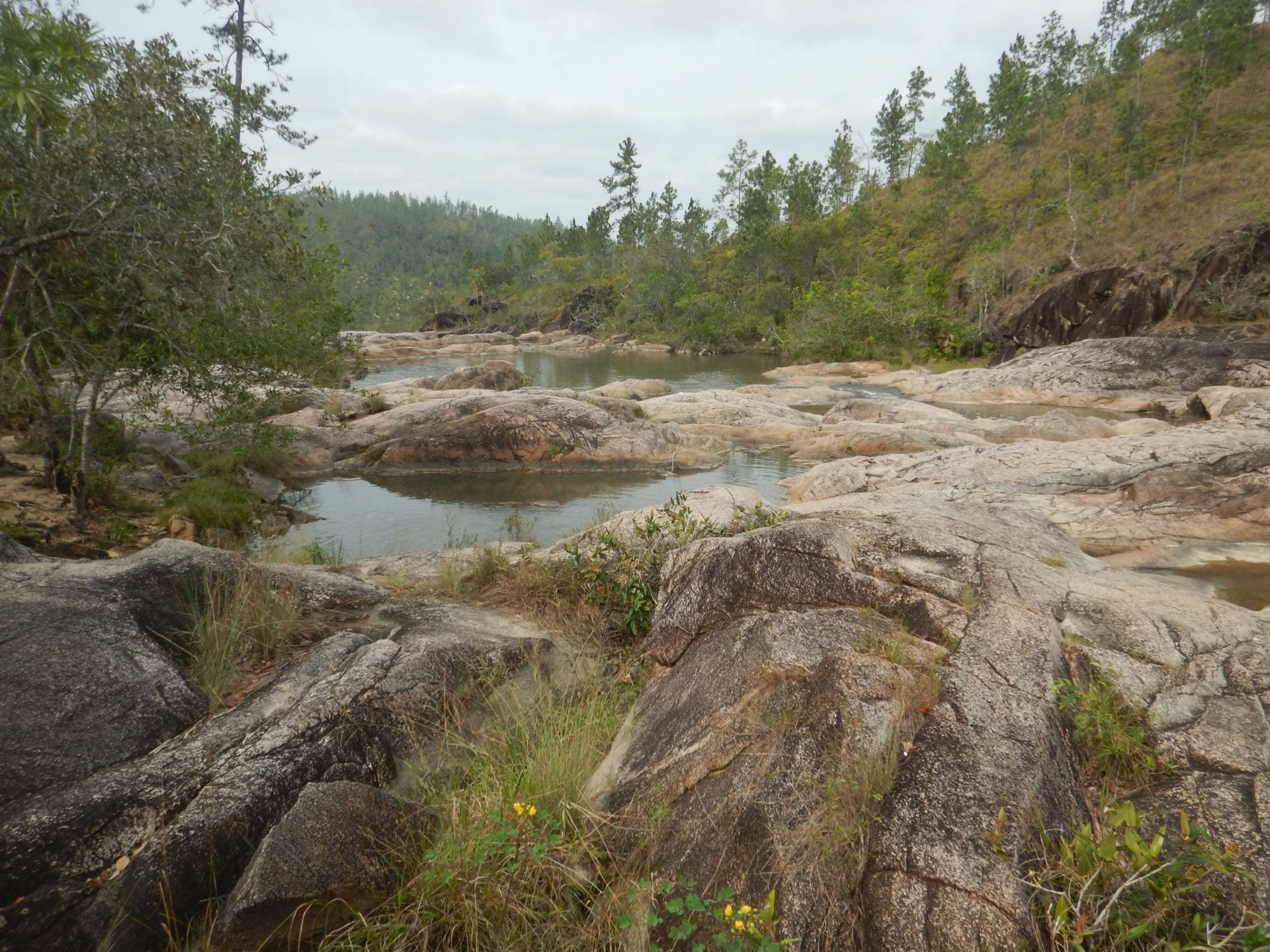
I awoke to the sound of birds (or rather, people birding). After breakfast and mourning my last hours of reliable WiFi, I loaded the van with the class to travel an hour to Rio on Pools in the Mountain Pine Range. While there, we swam, but mostly slipped, slid, and stumbled on the algae that blanketed the rocks. We also dunked our heads in waterfalls. Once dried and changed, we embarked on another hour-long  journey to the Caracol Ruins.
At the Caracol Ruins, there were many butterflies that appeared to be of the same species (a variant of swallowtail as indicated by long ‘tails’ protruding from each hindwing).  The ruins themselves were magnificent, but also a pain to climb; the steps of the ruins were so high that every time I took a step, my knees rose to my chest. It was all worth it though because now I can say that I have conquered the tallest structure in the country of Belize! Also, I stood within a tomb, which was dank, and the buttresses of a ceiba tree. After traversing the ruins, the class drove an hour to Las Cuevas Research Station, our final destination for the day.

Some other cool, miscellaneous things observed en route:

  • Mayan temple replica currently being constructed by a man who claims to be a descendant of a Mayan god
  • 3 military checkpoints, the second of which was a Dutch army base
  • carsickness 🙁

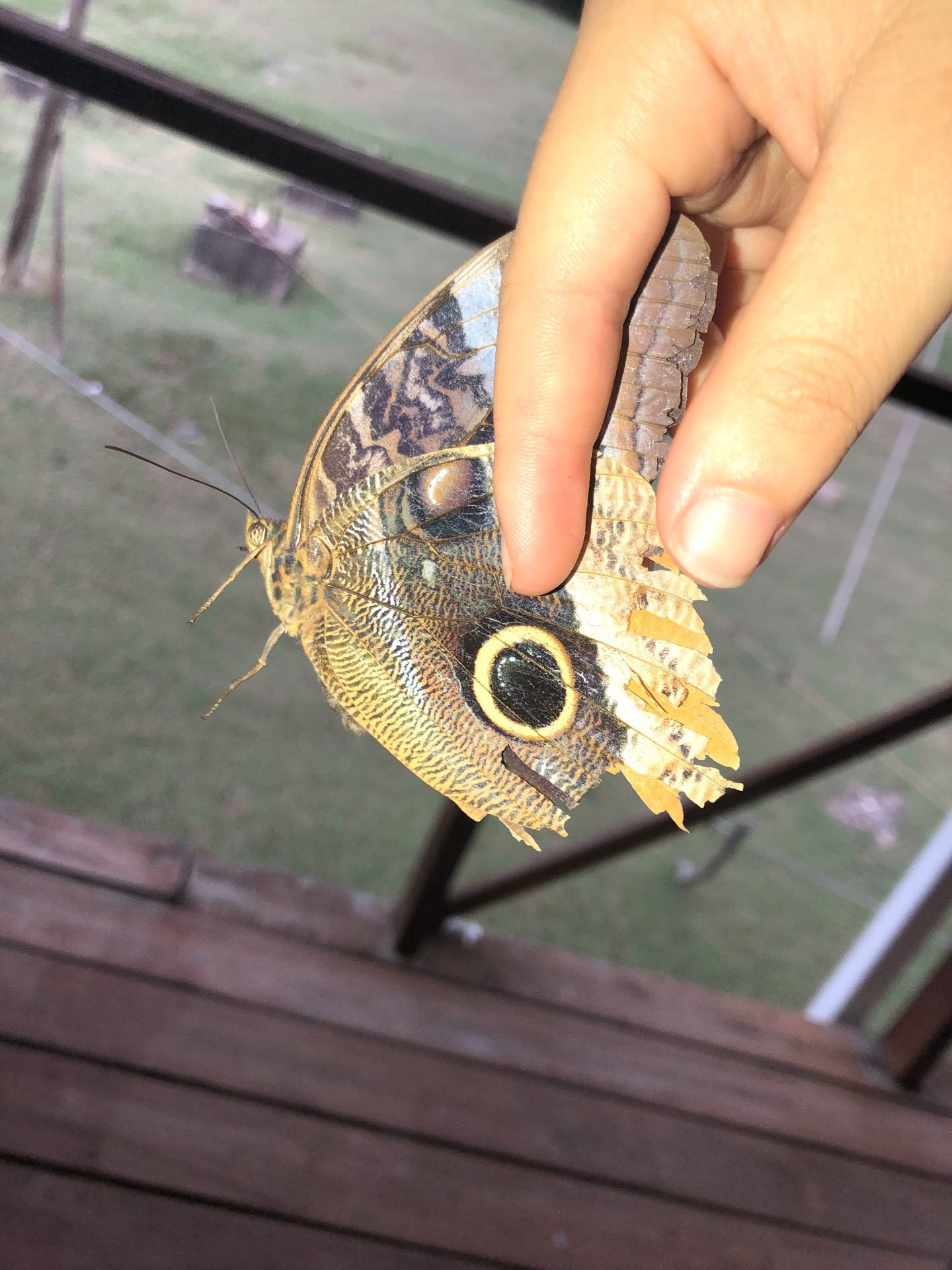
At Las Cuevas, I found and captured a butterfly in the restroom. It was sitting with its wings closed (as is the tendency of the butterfly), so I identified it as a butterfly even though the coloration (lacking in vibrancy) was more similar to a moth’s. The butterfly was tan/brown with an eyespot on each wing (forewing and hindwing, 4 eye spots total). The hindwings had significant perforations, but they were erratic in size and depth, so I believe that they were not present as a result of species-specific characteristic.

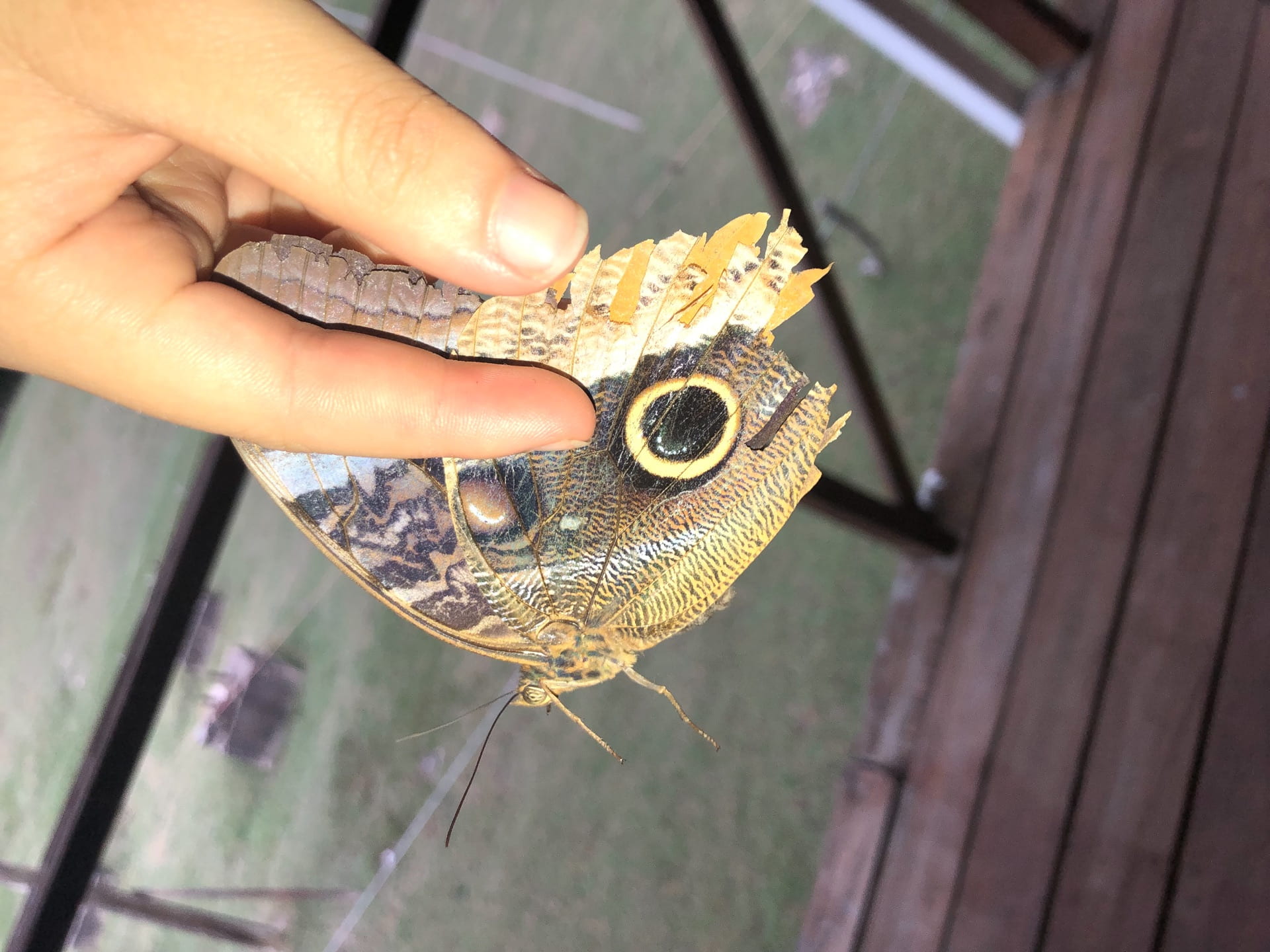
It began raining lightly (forest’s namesake weather!) Scott heard then saw a scarlet macaw.

After dinner, the class ended the night with a discussion on research question, and lectures on trees, birds, and the paradox of tropical soils.
Day 8: Snakes don’t scare me

Today we left Las Cuevas early and the last meal ever at Las Cuevas. This morning I had eggs, bacon, tortilla, banana bread, pineapple, and pineapple juice! My favorite drink! As we were driving away at 7:03am, I took a last glimpse of the research station and closed my eyes for a nap.

The ATM cave is a living museum and it was soooo much fun! The water was cold, and as expected, I fell at one point in time. literally always falling!! Seeing lots of Mayan artifacts and even some human remains very well complemented my expectations and the overall cave exploration.  Who knows how long this extraordinary place will be around and now I can say I have been to the most sacred cave in the world!

The sodas here at Belize are so good and they are so much better at keeping plastic pollution down compared to back home. We have plastic bottles and aluminum cans for our sodas while here in Belize, it is all glass. The drinks are so cheap!! $1 Belize dollar ($0.50 US Dollar)! They reuse the glass bottles saving the plastic waste, and this helps the environment. 

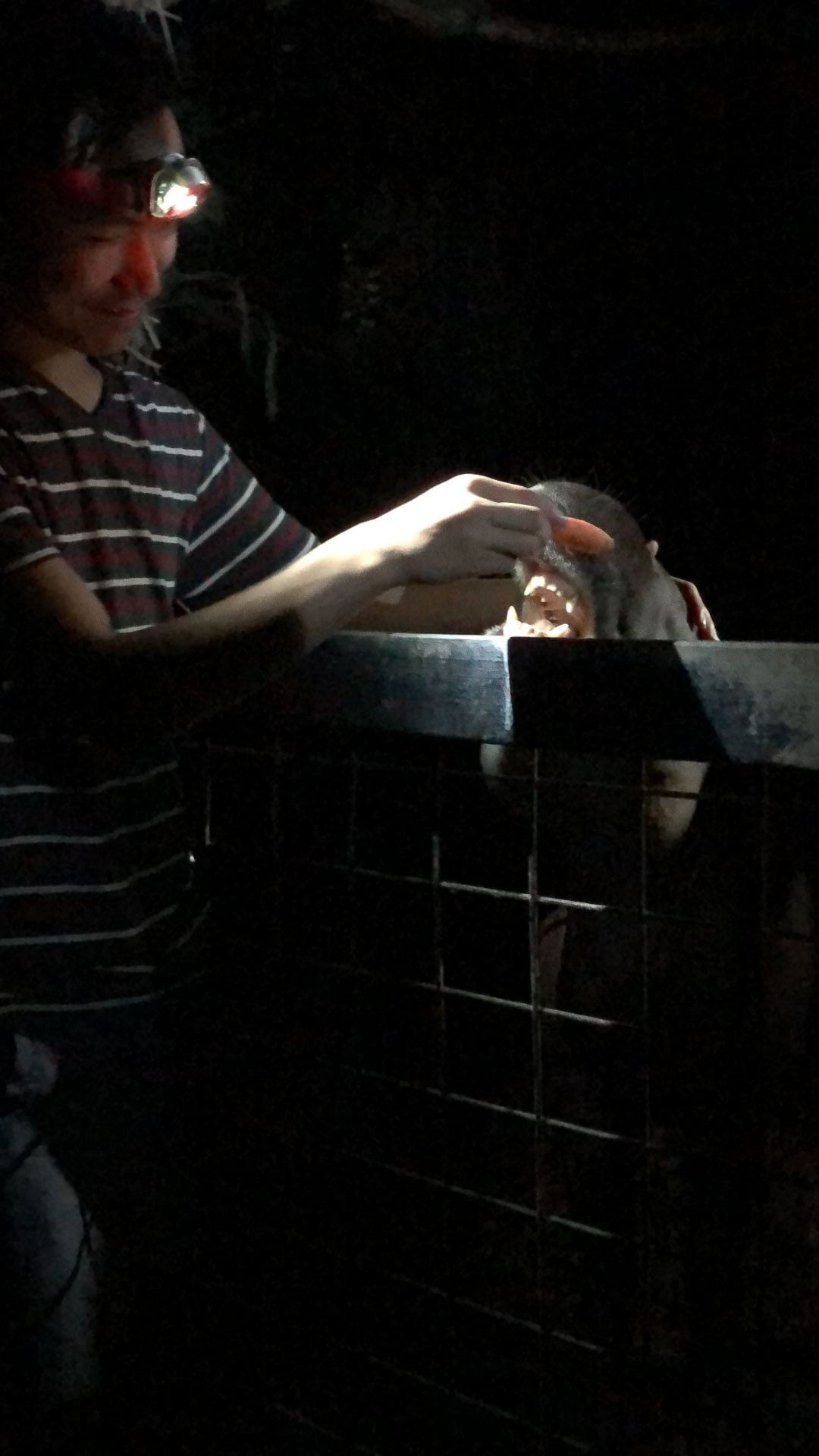
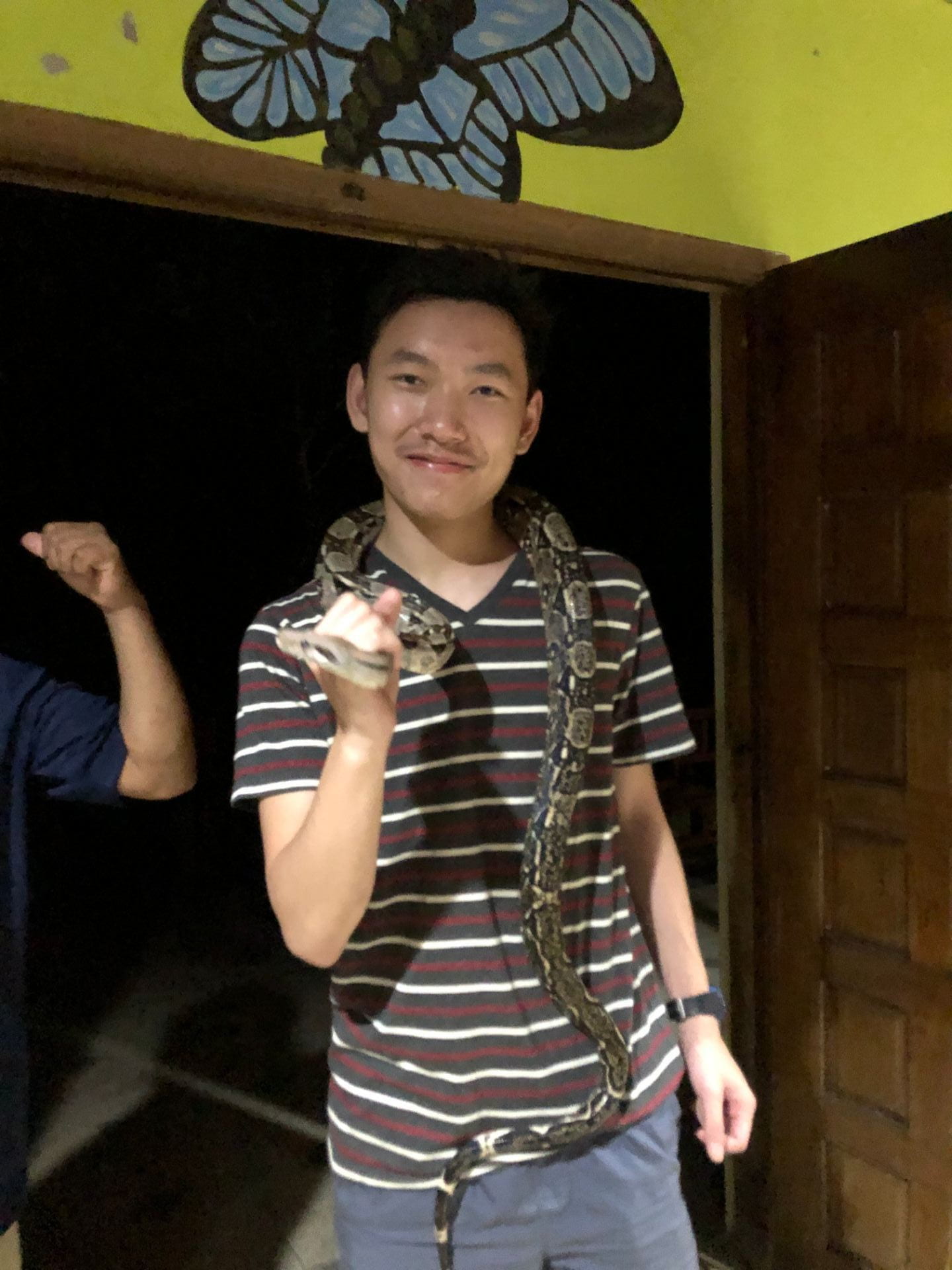
At the Belize zoo, I saw every animal that I did not see at Las Cuevas, and the zoo made the rainforest portion of the class more fulfilling. I feel like having the taxa epiphytes, I see them everywhere. I was fulfilled as soon as we entered the Chiquibul on our way to Caracol, but seeing the crocodile, watching the jaguar do his somersault, holding a snake, and even feeding a tapir definitely fulfilled my expectations and beyond. I hate snakes, never liked them, but after holding boba, I can say some snakes do not scare me anymore. See you tomorrow as we travel to Glover’s Reef Research Station!

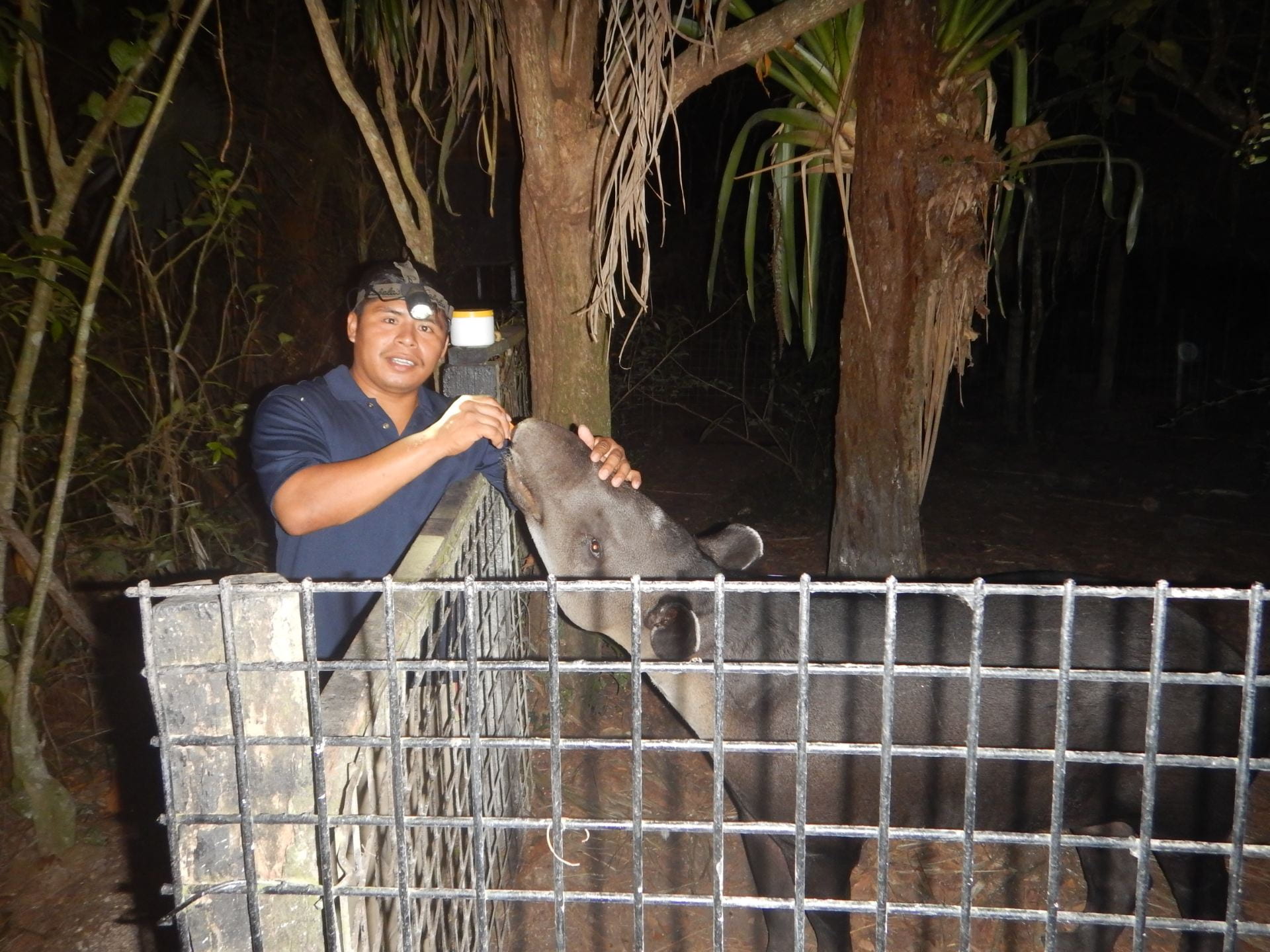
Picture: Me feeding the tapier!

Picture: Me holding the “scary” boa constrictor snake!


Day 2: Tour of the Caracol ruins

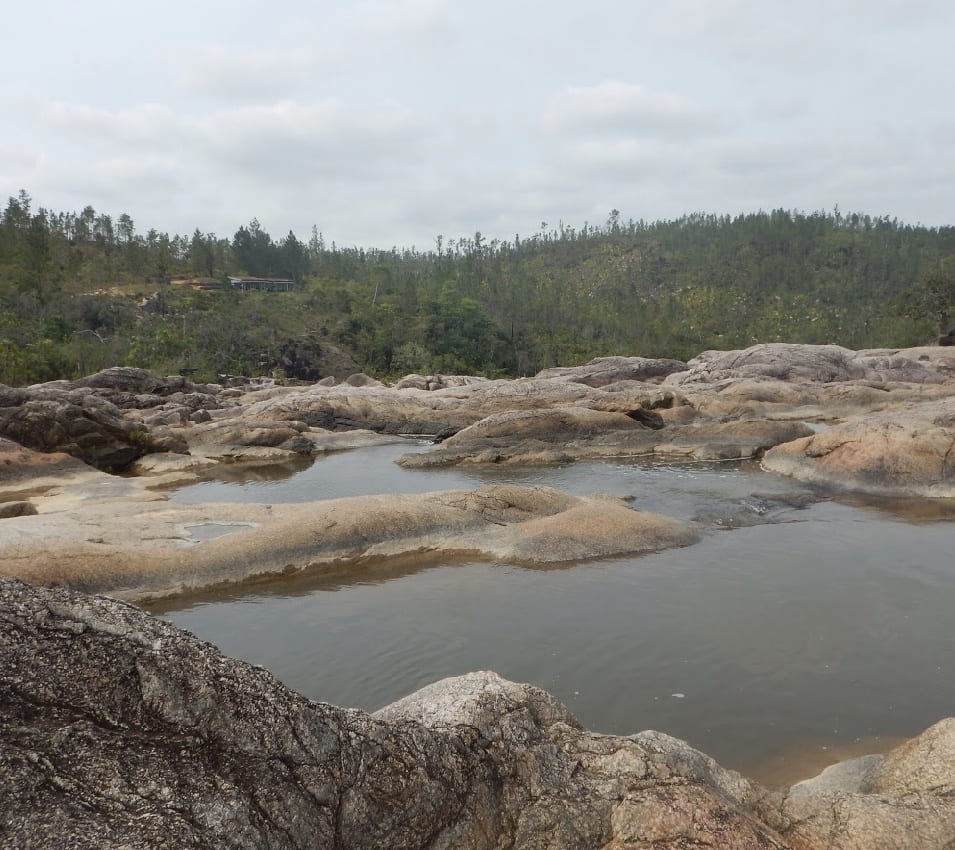
On the way from the Crystal Paradise Ecolodge to the Chiquibul forest and Las Cuevas Research Station, we stopped in two different places: Rio on Pools (in the Mountain Pine Ridge) and the ruins of Caracol, and ancient Mayan city.


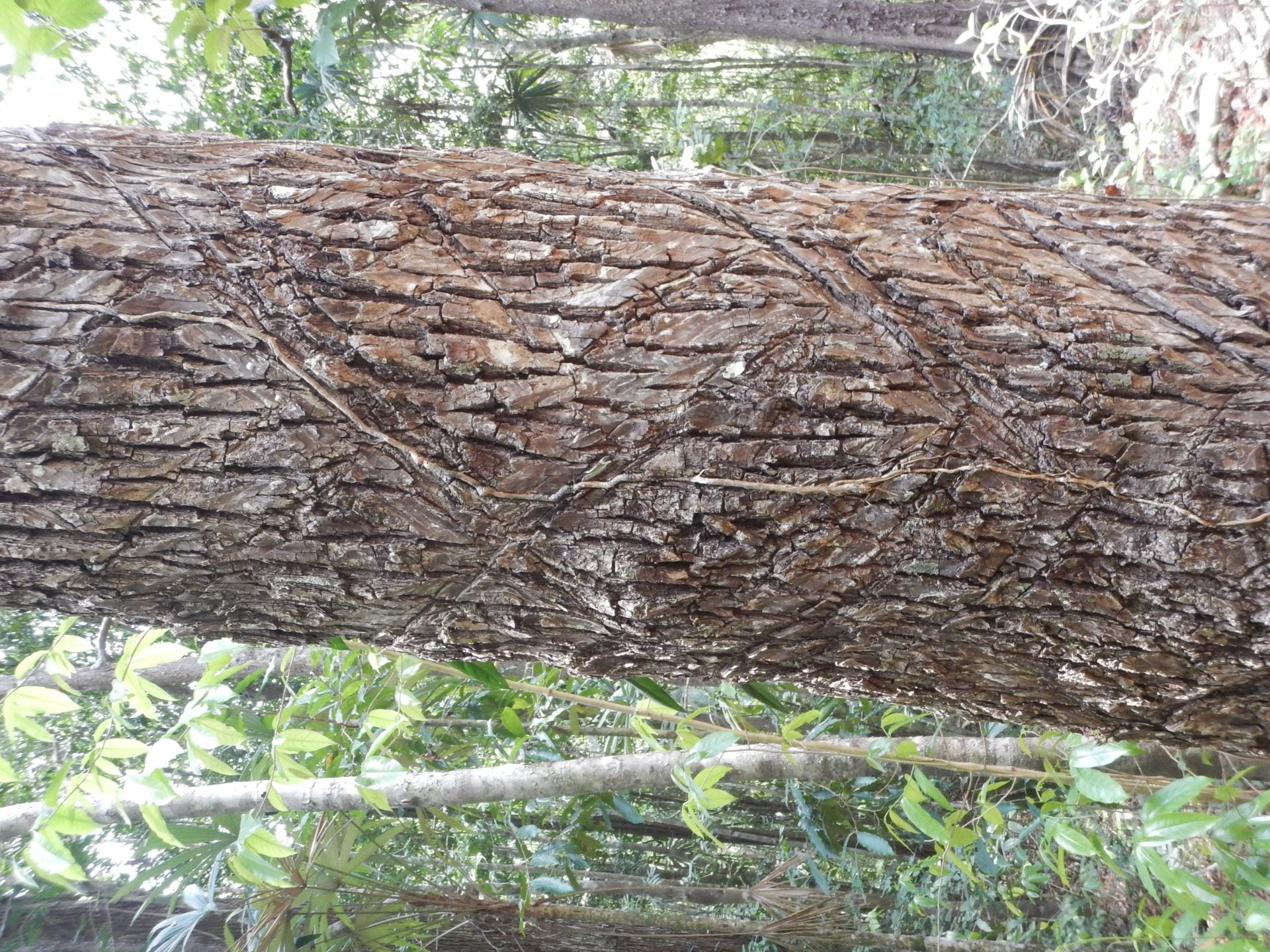
At Rio on Pools I took several pictures of trees that I want to identify when I get a chance (during daylight hours, when I can read the field guide). Of course, we saw the Caribbean Pine, which characterizes the Mountain Pine Ridge. For anyone reading this who does not know the regions of Belize, a ‘ridge’ is a description of a general area/ecosystem and not an actual landform of high elevation. I spent most of the time taking pictures, alternating between the trees and my classmates.

Rio On Pools
Rio On Pools

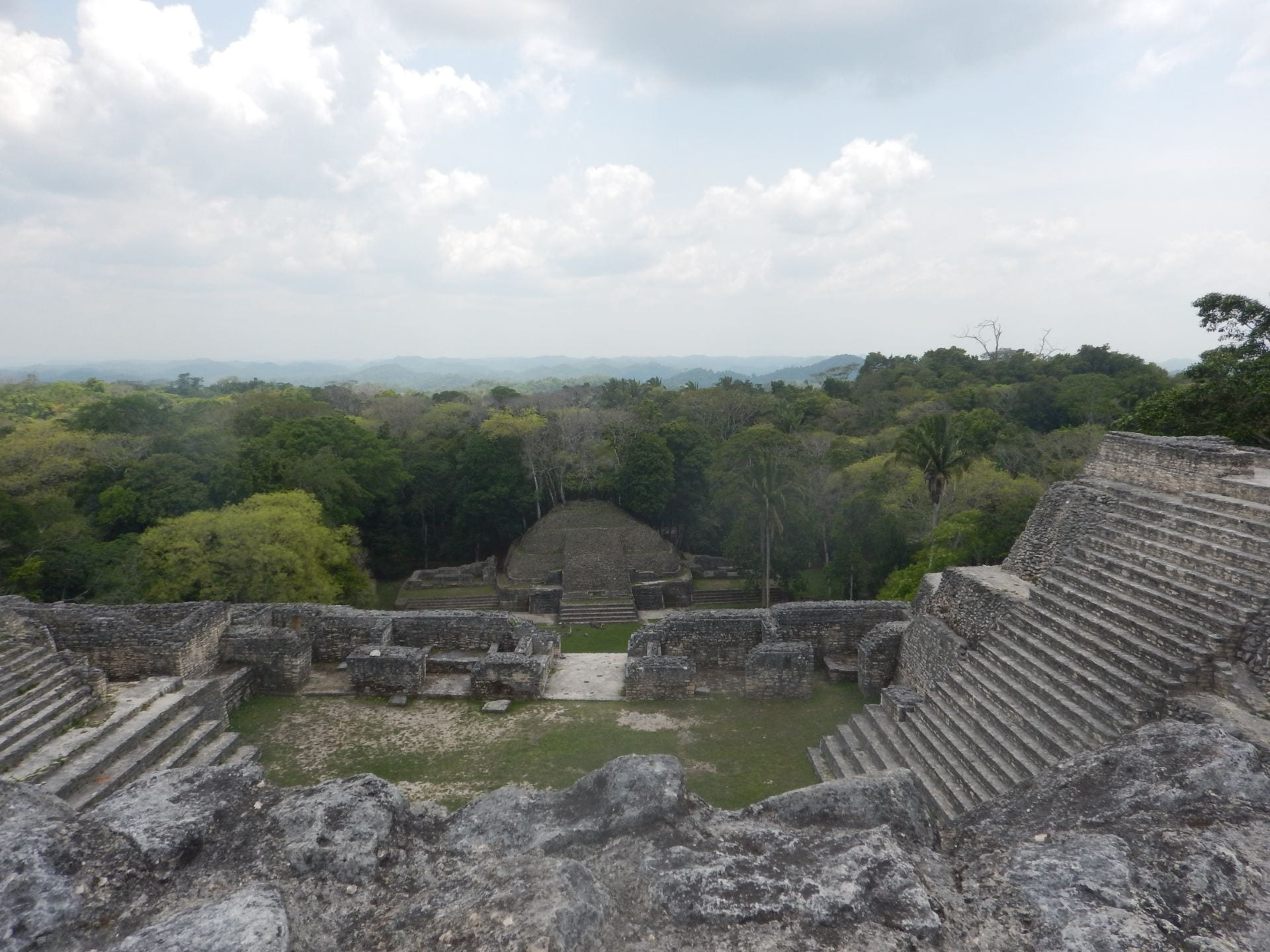
The Caracol experience was more notable in terms of learning about the region. The first time Scott came on this trip, he did not go to the ruins, but local people told him that it was entirely unreasonable to be this close to the ruins and not see them. The palace at the ruins of the ancient Maya city is the tallest building in Belize, and from the top (of course we climbed it!) you can see Guatemala. We learned quite extensively about the Maya for a few hours (religion, culture, social structures).


Caracol, from the top of the tallest palace/pyramid

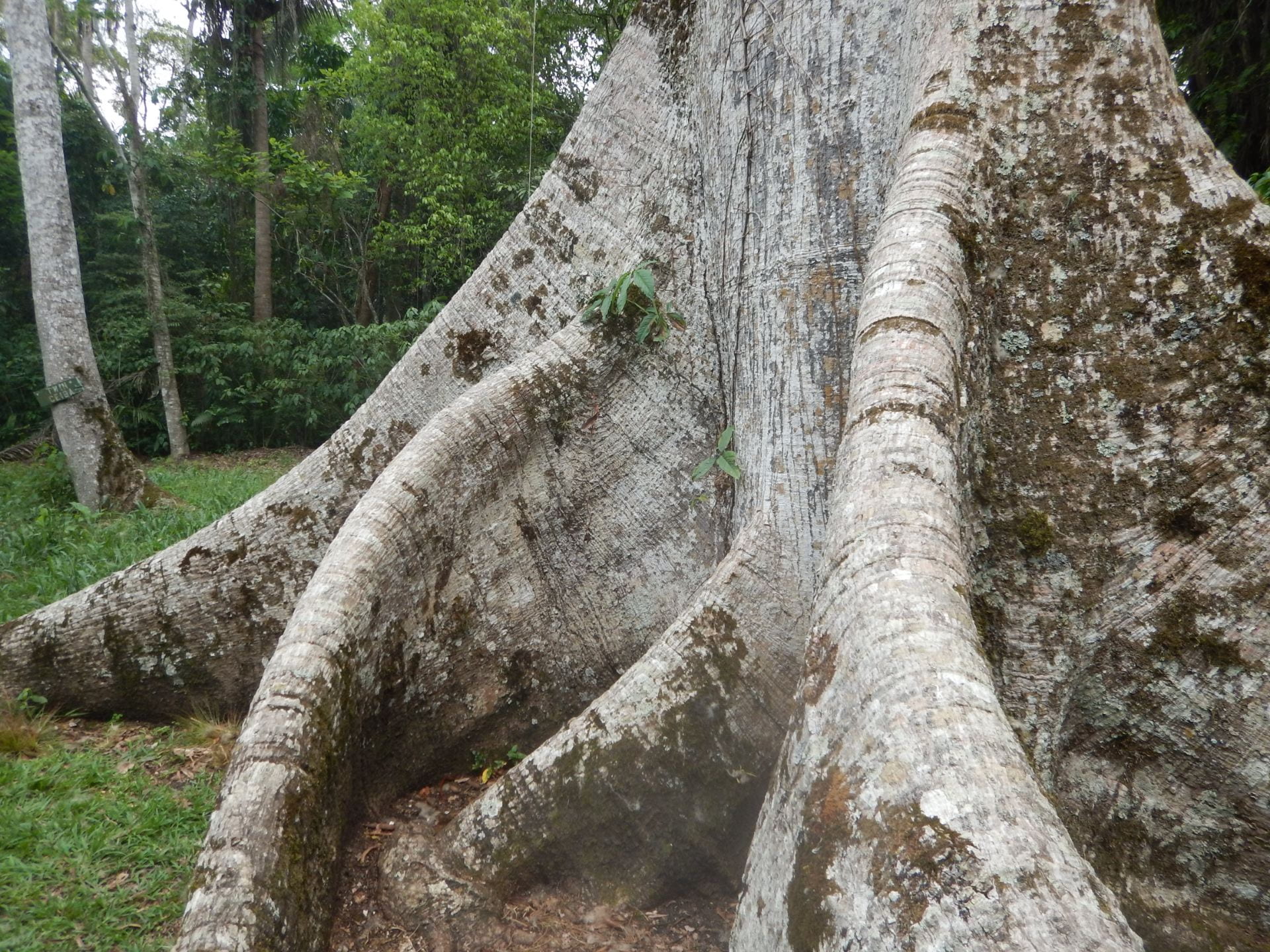
We also saw tons of trees. Our guide pointed out the Kapok or Ceiba tree (Ceiba pentandra) and the fluff that comes from the seed pods that I think he said was used as padding, for example in a mattress. The tree also has huge buttress roots extending from the sides that serve several purposes, including structural support and nutrient absorption. [insert picture here]

Kapok tree (Ceiba pentandra)

We also saw today:

A few more trees at the Maya site: Cohune palm (Attalea cohune), Fishtail palm (Chamaedorea sp.), more Trumpet tree (Cecropia peltata), relationship with guarding ant species, a Strangler fig (Ficus sp.), and some Montezuma Oropendolas (Psarocolius montezuma).

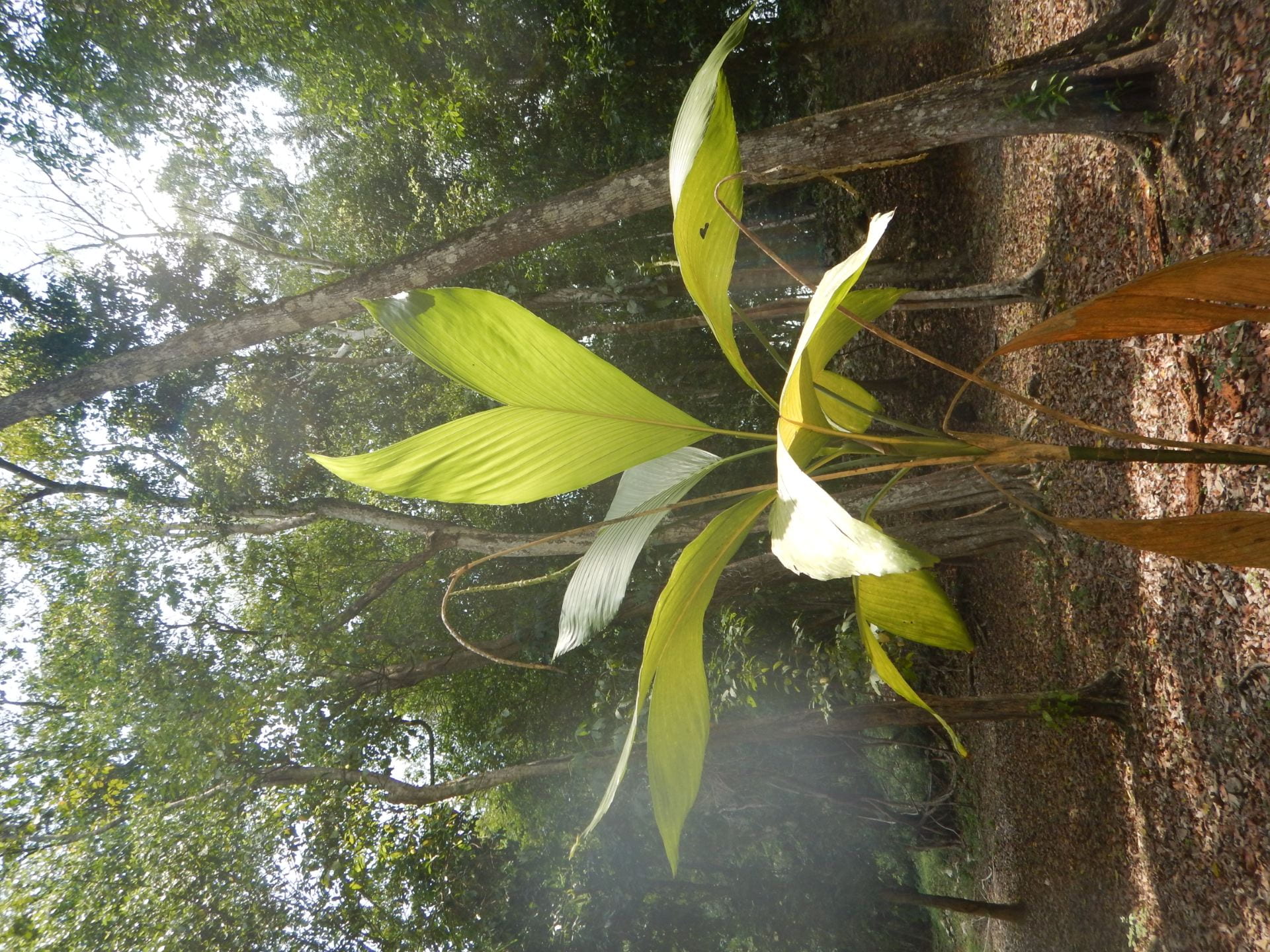
Fishtail Palm, Chamaedora sp.

At Las Cuevas: a Cedar (Cedrela odorata), A Scarlet Macaw (Ara macao) and a Social Flycatcher (Myiozetetes similis).

We don’t have internet today because of the weather. It appears that the rainy season has started early this year. We will get to see how that effects the visibility of our focus species.

Day 3: Monkeys and the Monkey Tail Trail

Today we set up the camera traps for our week-long research project. We are testing the impact of the human disturbance at the research station is significant on diversity of animal species, so we will count species and individuals caught on the traps over the week. Setting up the traps involved hiking multiple trails in the area, so we saw a lot of wildlife.

This morning we hiked to a 50 hectare plot, which is an area marked for research purposes, to set up three cameras in that direction at 15 minute walking intervals. Onn the way there, we saw a mahogany and a fiddlewood tree, which were marked by the research station. In terms of trees, we saw Give-and-Take palms, another spiny palm called a Basket Tie-Tie, several Gumbolimbo trees, and at least a few Sapodilla. We also saw a small tree that I thought might be a Poisonwood tree, but it was too small to tell for certain. I was using leaf characteristics for identification—none of us were willing volunteers to test out the burning properties of the caustic sap.

Chicle/Sapodilla (Manilhara zapota) with slash marks from harvesting sap for chewing gum

On the same walk, we also saw spider monkeys for the first time. They remained high up in the branches, but hung around to look at us. It seemed they were as curious about us as we were about them. “Observe how poorly acclimated to the forest are these humans,” their tour guide could say. And that would be true, although Scott said we would find the hiking easier at the end of our stay here. We did not measure distance, but we spent a few hours in the morning and another few in the afternoon hiking out to place the cameras.

In the afternoon we hiked the Monkey Tail Trail. It was threatening rain, but we only got a few drops and a few distant thunderclaps. It is possible that the rain was captured higher in the canopy by epiphytes (some of these are known as airplants) or other organisms and did not reach us on the rainforest floor. The trees we saw on this hike included more Gumbolimbo. I could see why this was called the tourist tree. It is given the name because it is red and peeling like the sunburn of a tourist unaccustomed to the intensity of the sun here. It is also used locally as a remedy for a range of ailments from colds to gastrointestinal problems to measles to sunstroke. We also saw the Bull Thorn Acacia, which has hollow pairs of thorns in the shape of a bull’s horns which are inhabited by ants. The tree produces food and provides shelter for the ants in a way that induces the ants to defend the tree as they would any other nest. As a result, if you disturb the tree (especially if you break a thorn), you may be attacked by ants. This protects the tree from predators and describes a symbiotic relationship because both species involved benefit.

In addition to some interesting beetles, we came back from the hike with quite a few ticks each. Apparently ticks here don’t carry any serious diseases, but are mostly a nuisance. Picking them up today was the result of travelling an overgrown trail, and especially affected those who were not wearing insect repellant and/or were not trying as much to avoid brushing against the brush.

Note: We still have very limited wifi and may not be able to post at regular intevals.

Day 4: Getting Our Rainforest Legs

Scott said that after a few days of hiking in the rainforest, we would start to feel more energetic and less exhausted. This despite our full days. I think a few of us are starting to feel this. Today started with more bird watching, for everyone else. I slept through bird watching and went to breakfast at 7 instead. Right after breakfast and until lunch we set up an experiment to determine nitrogen limitation on the forest floor versus in the canopy by using human urine. Where did we get human urine? Guess.

We set up vials of urine and water along a straight trail every 200m. We also saw a cave full of what might have been Leaf-Nosed Bats, another Cedar tree (Cedrela odorata), and a Bay Cedar (Guazuma ulmifolia). Liz still has yet to catch a Blue Morpho butterfly, but we can identify them well from a distance. They are an iconic rainforest animal.

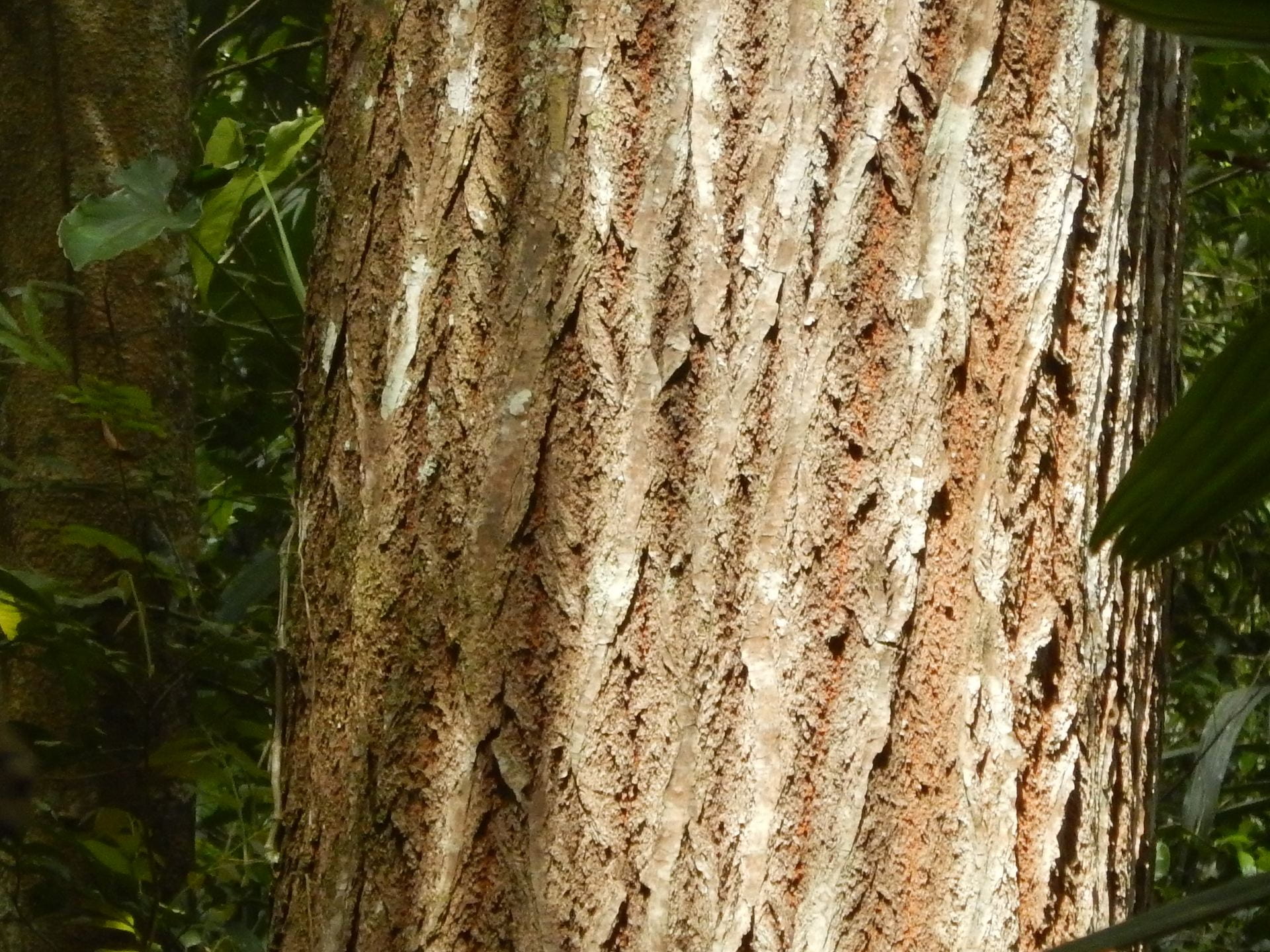
The bark of the Spanish Cedar (Cedrela Odorata)

In the afternoon we went to a cave and held the day’s lectures in it. The cave was home to an ancient Maya religious site, and walls and platforms built by the Maya for ceremonies are still standing today. On some platforms Mayan pottery remains. We also saw either swallows or some other bird nesting in the entrance. There were cave crickets and a millipede, and many interesting formations, in the cave.

In the evening we went on a short night hike (not too far from the station clearing) looking for night creatures. Much of the fauna of the rainforest is more active at night than during the day. We saw a Central American Tree Snake, lots of colorful beetles, moths, a scorpion, a tailless whip scorpion (not actually a scorpion, though an arachnid), leaf cutter ants, an orb weaver and some crickets. We also saw a Wolf Spider with its abdomen absolutely coated with little baby spiders. This stage does not last long, so we were lucky to see it. What we saw at first was a yellow shine where the eyes of the spider were and what looked like a huge abdomen with green glitter. Those were the eyes of all the baby spiders.

Wolf spider with babies crawling all over its abomen (green glitter = eyes)

Day 8: We need to talk about: the ATM Cave and Belize Zoo

5/21/19: Today, we left Las Cuevas and said goodbye to Rafael, the station manager, and the other LCRS staff. If I am being honest here, waving goodbye to them was really sad because they were so nice and accommodating the whole trip. However, the feeling of sadness soon left when we arrived at the ATM cave. I have to say this was one of the best experiences of my life.

Not only was it amazing seeing a cave of its magnitude in person from the outside, but also being able to swim and explore the cave firsthand was incredible. I felt like I was basically Indiana Jones crawling through those cave walls. I have never done anything like that, and I recommend if you ever come to Belize, make sure to schedule a tour of the ATM cave. It is a once in a lifetime experience.

One of the zookeepers from the Belize Zoo feeding the Tapir

Next, we went to Belize Zoo and it was one of the coolest and, might I say, cutest experiences. The zoo prides itself on preserving Belizean native animals (how awesome is that!). They also have so many funny signs around the zoo describing the animals; you can tell they put a lot of time into it. We saw a boa constrictor, tapir, puma, jaguar, margay, barn owls, pygmy owls, Morelet’s crocodile, and a gibunt. I even petted the tapir and held a boa constrictor! We were not able to see most of these animals at LCRS, so I am so happy we were able to see them before we left. I am starting to feel like a piece of me belongs to Belize. Next time you hear from me, I’ll be at Glover’s Reef.

Holding a Boa constrictor at the Belize Zoo (one of the best moments of the trip)

Wish me luck!

-Bella

Day 5: A Research Project in a Day

Rainforest Canopy

Today we spent the whole day on the pitfall trap research project. We had tied some vials of urine and water to trees and buried some in the ground to collect arthropods (briefly, bugs) and compare diversity between the canopy and the ground. We collected the tubes in the morning starting around 7am, finished an inventory by noon, and spent all afternoon until 5pm making a poster and presentation which we then presented to Amanda and Scott. We were all getting pretty tired by the end of the day, and some of us started giggling with I assume relief at the end of the presentation.

We didn’t see any new trees today, but I identified a Bay Cedar (to be fair, it is also marked with a sign along one of the trails) (Guazuma ulmifolia). I found it in a field guide using the fruit. The small, spiky fruits smell like honey and are a source of fodder for grazing animals in the dry season. However, apparently small children tend to eat them, and in large quantities they can lead to constipation, which leads to names probably coined by the parents such as stuck-up-da-butt nut or plugabutt.

We saw some more cedars this morning. They are called Spanish Cedars (Cedrela odorata), but here they are just referred to as cedars. The bark has long vertical ridges and can have darker valleys, an identification similar to that of corals (my reef taxon group!). It is easiest to identify them as large trees, and there are several such along the various trails. We have at least seen them on the “flagpole” trail to the 50-hectare plot and the Maya trail. There is also one in the clearing right in front of the cabin.

This evening we saw a lot of cool stuff. That could describe any day, but today Kaela showed me some nightjars that I identified with the help of a guidebook and Scott’s knowledge of local bird names. Apparently it was a Pauraque, which is pronounced “par-ahq.” I thought it was “pear-uh-quay” or “pear-uh-kay.” I’m learning all sorts of new things on this trip.

Day 6: The Poisonwood Tree

We spent the whole day today working on more research projects, then hiked to the bird tower for the sunset in the evening.

Morning: Assessing differences in plant diversity between hurricane disturbed and undisturbed areas using sampling along transects in disturbed and undisturbed areas. From this we could not reject a null hypothesis that the diversity was the same between disturbed and undisturbed areas (couldn’t say for sure whether there was a difference at all).

Afternoon: Assessing the toughness of young Trumpet Tree (Cecropia peltata) as a protection against herbivory before colonization by Aztec ants. To do this, we had to measure the toughness of many trees of this species with a specialized tool, including trees colonized by ants. The bite of these ants isn’t too bad—speaking from experience here—but we each exposed ourselves to them as we each tested the leaves of a one tree colonized and one uncolonized by ants. We had to bend the trees down because they are very tall—I will attach a picture here—and this would cause the ants to rain down on us. Once we finished, we also had to climb over ant covered trunks that we had felled across the trail.

It is worth noting that we did not at any point go through the rainforest felling trees on a whim. This Cecropia species is a pioneer species, meaning it grows rapidly and colonizes sunny areas, so in a way it is accustomed to recovering from destruction. Most of the ones we severed were fairly young, as well, and we avoided damaging the trees where possible.

In the evening we went to the bird tower. On the way up we finally saw a White Poisonwood tree (Sebastiana tuerckheimiana)! The tree has had a few other scientific names, but this appears to be the most accepted version. It is not a widespread species and can be confused with the other poisonwood tree in Belize, the Black Poisonwood (Metopium brownei). Poisonwood trees are felled only by brazen individuals who are accustomed to the effects of the extremely caustic sap which can be found in many parts of the tree, most notably, of course, the trunk. However, it is highly sought after by some carvers and woodworkers for the exceptionally hard and smooth wood. I was excited to finally see the infamous tree from a safe distance.

White Poisonwood tree (Sebastiana tuerckheimiana)

We also saw a Cedar (Cedrela odorata) again. This time I recognized it by its pods, which pop open, the casing forming a four-pointed star with a small nut in the middle. I then looked up and saw the tree. It seems to grow in more exposed areas, but all of the ones I have identified are quite large, so it is difficult to tell what the surrounding area might have looked like when the tree was young. I have also seen them deep in the forest, however.

We had an amazing view from the top of the bird tower, but sadly the sun was obscured by clouds. I will include a picture when I have one. Someone commented that we could see nothing from the top of the hill, especially without climbing the tower, but we saw a few animals while there as well as the view. Of course, we were still surrounded by trees! There is always something new to see here.

Day 7: WE SAW THE FOREST COW!

We spent this morning retracing our steps from Day 2 to collect our camera traps, but were kept in suspense all day as to what we had caught on them. Scott did not seem optimistic, because on some traps there were only 12 or 13 captures, about the number he would expect from triggering them ourselves by walking past.

In the afternoon we analyzed our data measuring the leaf toughness of Cecropia trees, also called Trumpet tree (Cecropia peltata). Because of the variation in the penetrometer we were using, we didn’t have conclusive results surrounding the correlation between leaf toughness and colonization by ants. Scott also said that in prior years, he had not found such large individual trees lacking colonization by the mutualistic Azteca ants. A queen of the ant species usually colonizes the tree when it is rather small, then there is a delay while eggs the queen lays hatch into workers. They live in the tree because it has a chambered stalk that provides shelter and the tree also has extra-floral nectaries, which essentially means that it provides food for the ants as well. So, when herbivores threaten their home, the ants attack, which benefits the plant. What we were investigating (inconclusively) was whether the leaves might be tougher in trees not colonized by ants yet because they would have to defend themselves against herbivory.

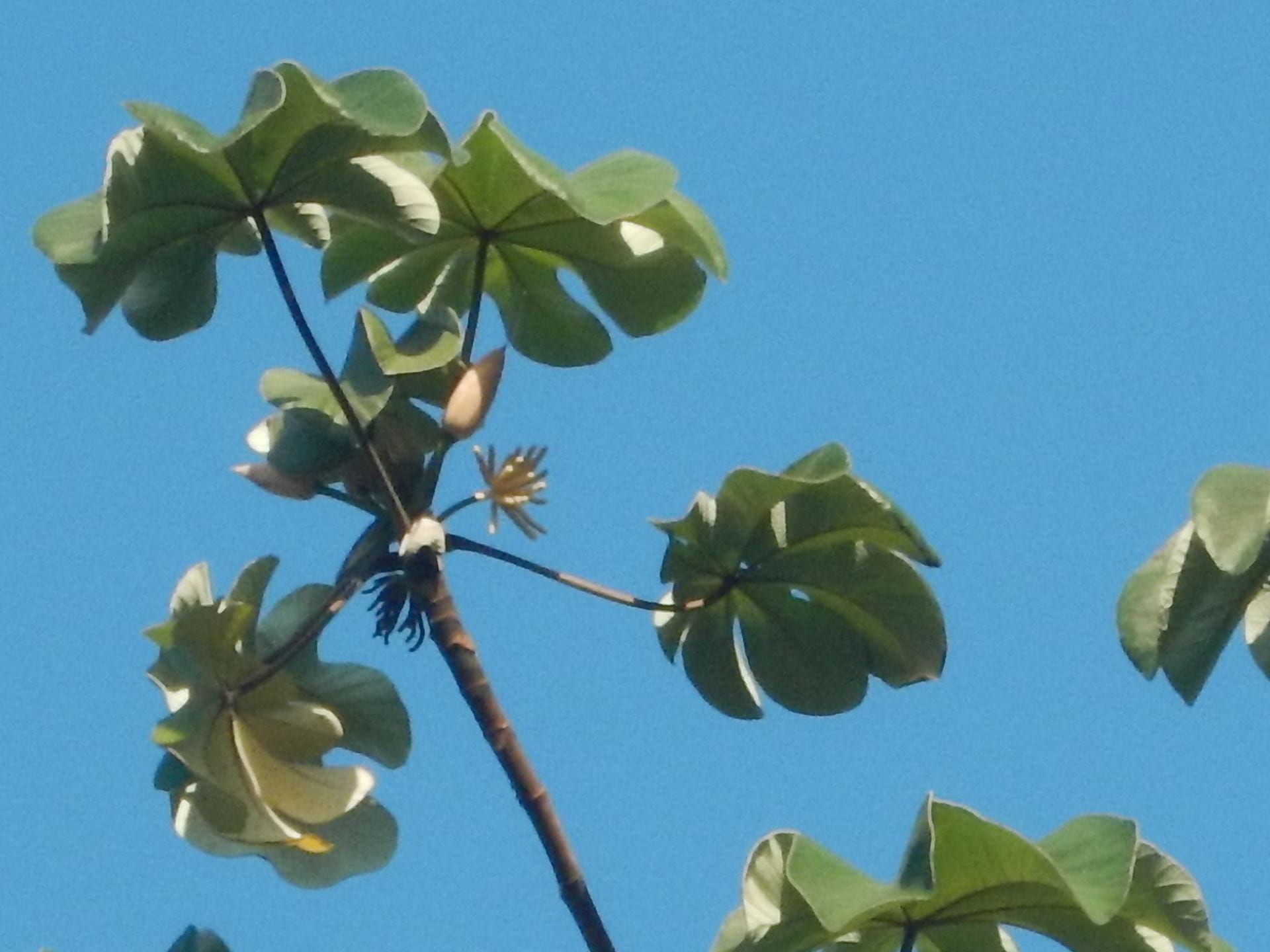
I did some research during the break we took after this and realized that the tree we were working with was Cecropia peltata and not Cecropia obtusifolia, which was the species on my taxon ID card. The clarifying difference was the greater depth between the fingers on the leaves of C. obtusifolia. The leaf overall has a hand shape.

Trumpet tree (Cecropia peltata)

I also figured out that a small tree / bush in the clearing where we saw the scarlet macaws the other day is a guava tree (Psidium guajava). I was befuddled by the identification keys in the Costa Rica and Panama book, but figured it out using the Belize guide. I was able to figure out that it was in the Myrtle family (Myrtaceae) from the first field guide, but I didn’t figure out the exact plant until I dropped the rather worn, thin version of the Belize guide. It had gotten wet a few times, and pages were falling out. On putting the pages back in order, I saw the guava fruit. I pulled the other one out of my pocket to compare, and it was the same. I got the family right, too! I know much more about the trees here on a family level than I do those at home in Texas.

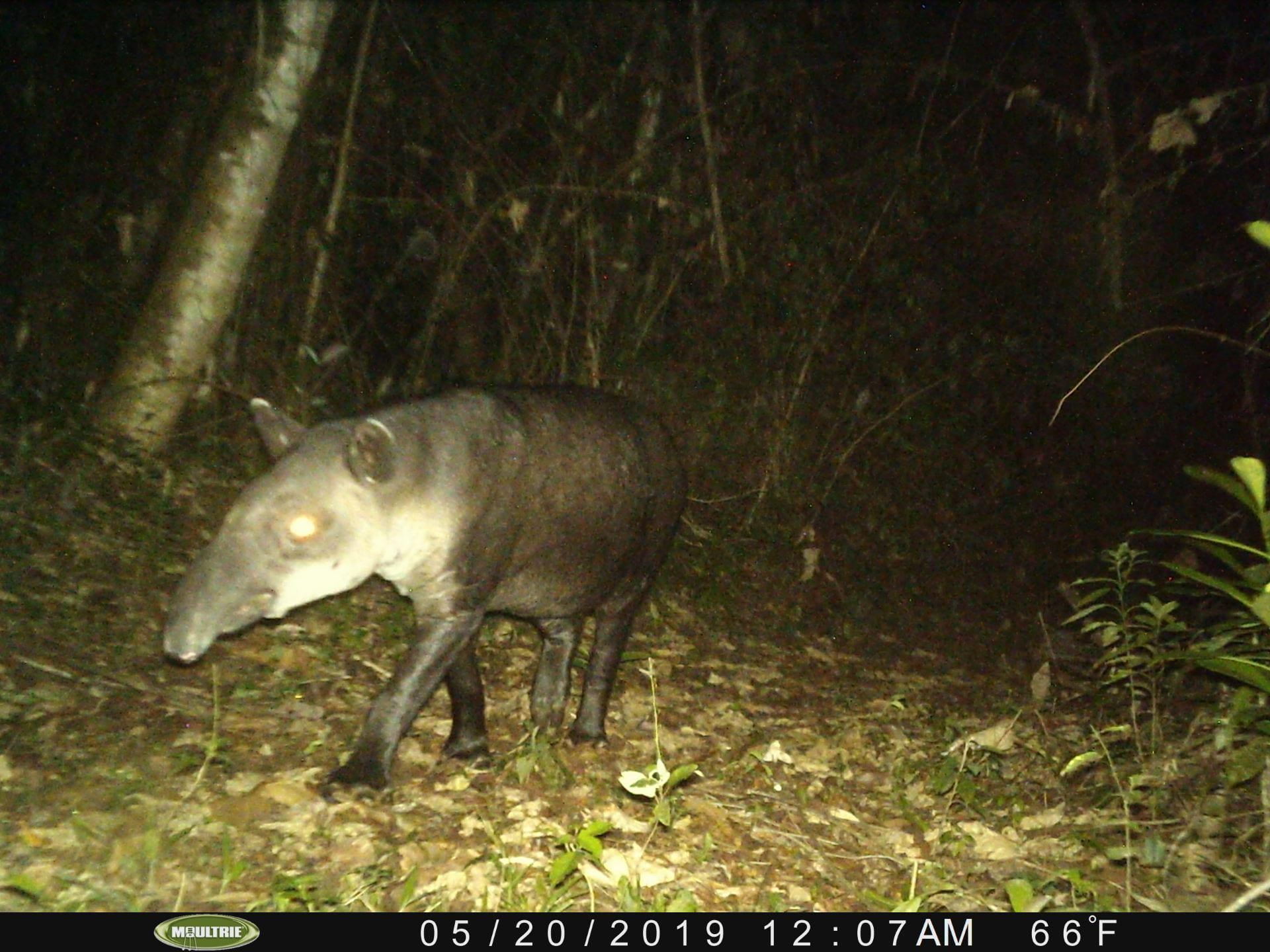
When we finally got around to checking the images on the camera traps in the evening, it was immediately after two presentations, on the biogeography of the region as a whole (including Caribbean) and on mammals. The lecture on mammals turned out to be relevant; we saw a silhouette that may have been a puma, a rainforest rat of some kind, a few birds including a Curassow, and a tapir! Tapirs are huge mammals with long snouts and are herbivores. Apparently, they aren’t aggressive, but like many large mammals, they could hurt you unintentionally. Scott relayed a story of being bitten by a friendly one in Brazil. When he got back to the research station, they said, “oh, you met [name of the tapir]?” Apparently it was often fed, and if you didn’t feed it, it would nip you. Anyway, we got a pretty good image of the tapir, and our results generally supported the hypothesis that the wildlife stays away from the immediate area around the camp—the nearest cameras did not catch much, while the farther ones caught tapir, puma, a skunk, an opossum, and the others mentioned above.

Tapir on the camera trap!

Day 8: A jaguar does somersaults

Today we left Las Cuevas very early in the morning. From there, we drove three hours to the ATM cave. ATM is an abbreviation for a Mayan phrase Actun Tunichil Muknal meaning roughly a cave with a stone tomb in it (or, Cave of the Stone Sepulcher). We crossed a river several times and then had to swim into the cave—the water was too deep to wade. After winding through several half-submerged crevasses, we climbed up a steep “cliff” of rock and were asked to remove our water shoes. The reason for this was that people without shoes on are more careful about where they step.

We saw increasing levels of Mayan artifacts after that point, which were sacrifices they made primarily to the rain god. The age of these artifacts was from 700 to 900 AD. First, there were pot shards, then whole pots (they would puncture a hole in them to make sure they would not be taken and reused). After that, we saw a bowl of a type used for bloodletting ceremonies, then finger bones, then a skull. Then the skull of a baby. Then, finally, in the last chamber we entered, we found an entire skeleton that looked as though it had fallen into position.

The escalating sacrifices may have been caused by increasing levels of drought and hardship caused by increasing deforestation. The Maya turned to the rain god, and the way they knew to appease the god was to sacrifice. They raised the value of the sacrifice and would go deeper into the cave because the caves are considered to be closer to the underworld.

When we arrived at the Tropical Education Center, our intermediate stop between the Las Cuevas Research Station and Glover’s Reef, I immediately noticed the birds. There were a couple of flycatchers similar to the Social Flycatchers we saw at Las Cuevas nesting in a Caribbean Pine (Pinus caribbaea). One fo the nesting pair was sitting next to the nest, and the other in a nearby trumpet tree (Cecropia peltata). The pines are much more common here—the only one I remember from Las Cuevas was in the clearing, and may have been planted. The reason the pines are more common here is that we are in a different region here, the Pine Savannah. This is the same region we went through to get to Las Cuevas, where the savannah was burning in patches because it is still the end of the dry season.

We went on an evening tour of the zoo, and we each held a boa constrictor to pose for a picture. Then , we looked at the different animals in the zoo. While we were looking at the owls, trying to get a good picture through the wire mesh, there was a sound behind us of leaves crunching. Apparently I dismissed it, which is alarming, because when we turned around, Scott pointed out that the jaguar in the opposite cage had been stalking us! As it turned out, more likely it wanted to be fed, and on command it performed an obstacle course and then a series of somersaults each for the reward of a small piece of meat. The incredibly strong jaws of a jaguar can kill prey by crushing the skull!

Holding a boa constrictor
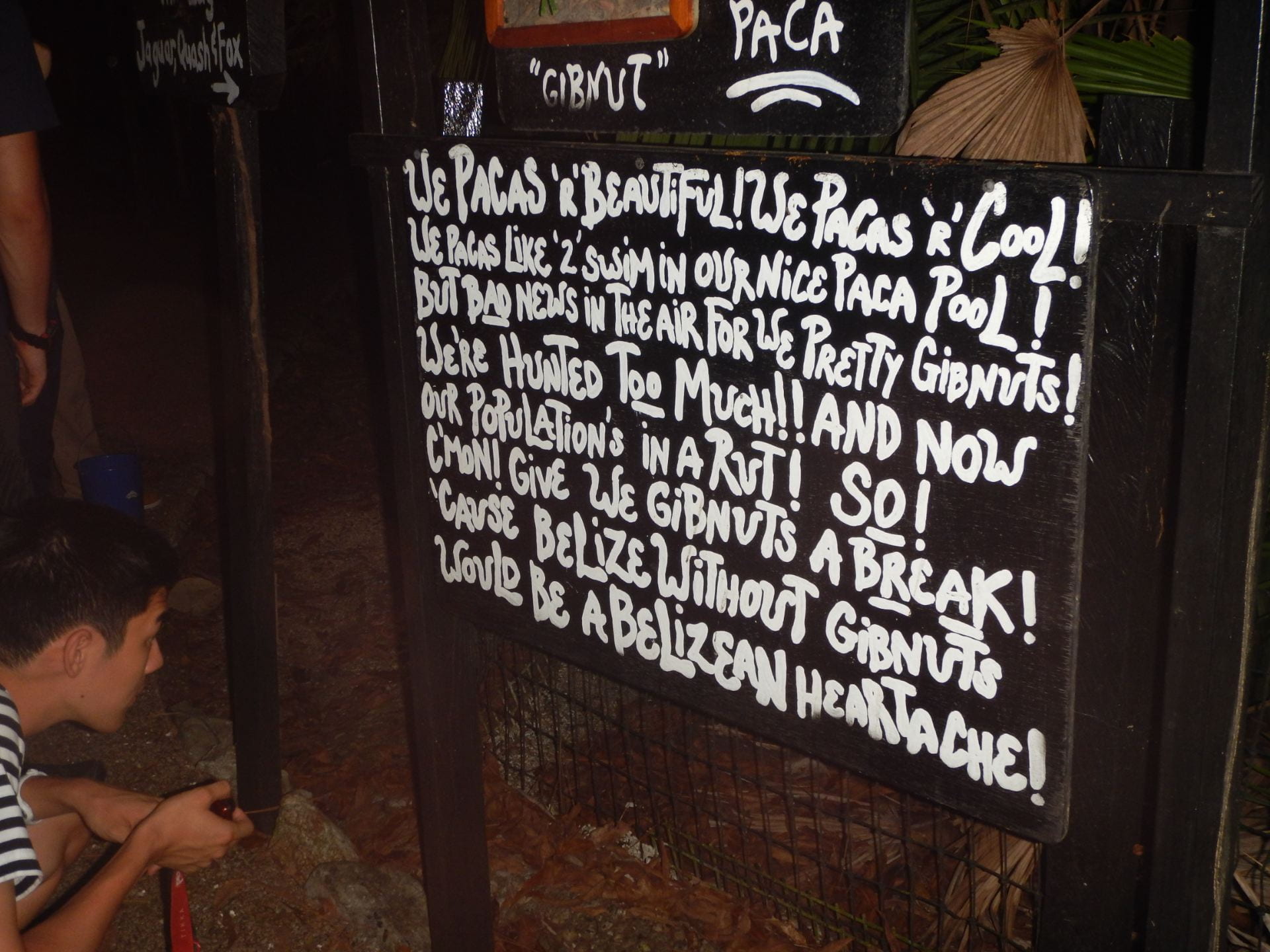
Zoo sign for Pacas

-Amy

Rice University