(Never thought I’d say this but…) it was nice to sleep in today now that breakfast is at 7:00am! Today is our first day working on the reef!The class went out to the coral graveyard to practice the point-intercept and quadrad methods of conducting surveys, then examined coral skeletons taken from the coral graveyard. We attempted to identify the coral skeletons species or at least genus; we identified a range of corals including Pseudodiploria, Colpophyllia nattans, Agaricia, Pendrogyra cylindris, Acropora palmata, Gorgonia ventalina, Siderastrea, and Fabullata. There is so much variety in corals and coral structure on the macro and micro levels, yet corals are deceptively hard to tell apart, especially when it comes down to specific species.
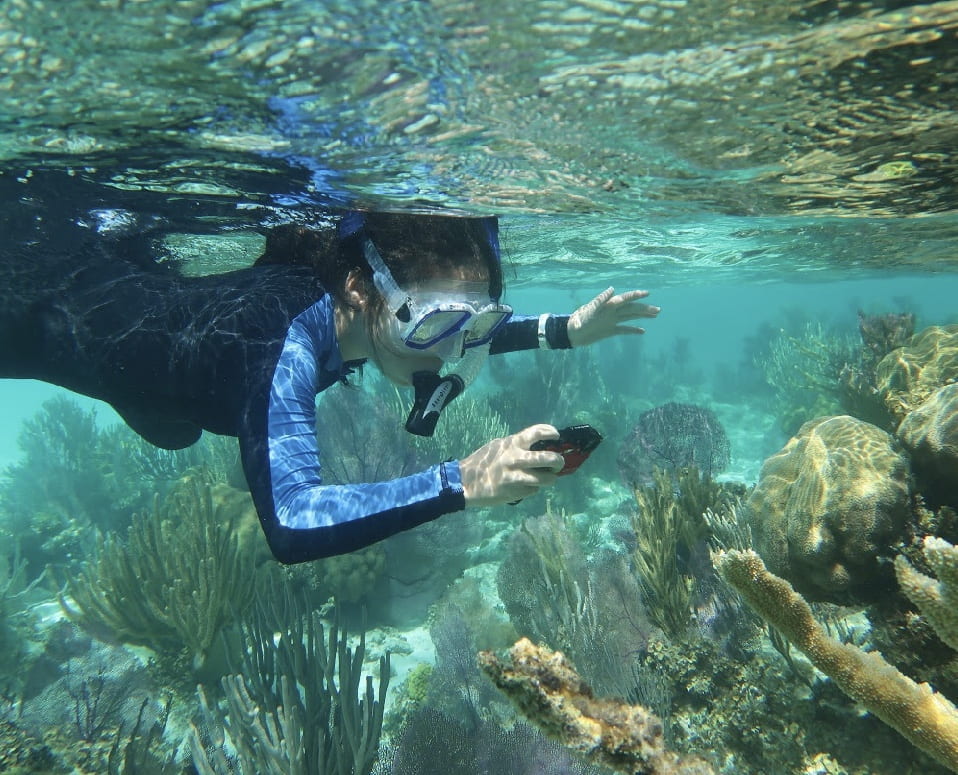
Later in the day, we utilized the quadrad method on sea-grass and algae. Cassia and I developed a set of hand-signals to communicate data under water that enabled us to complete the transects relatively quickly. Using tools under water was a surreal experience! First, we had to swim over to the sand bar within the sea-grass/algae area carrying our bulky PVC quadrads, transect tapes, and clipboards for recording data. Writing under the water with water-proof paper and pencil was a novel experience for me, and its a technique that we will be utilizing a lot in the coming days. At the patch reef, I saw several yellowtail snappers, and a nurse shark (the couch potato of the ocean)! Hopefully, we will see more piscivorous fish in the coming days.
We ended the night with lectures on echinoderms (go sea cucumbers!), green and red algae, and mangroves and seagrass beds (their relevance and importance to coral reefs).
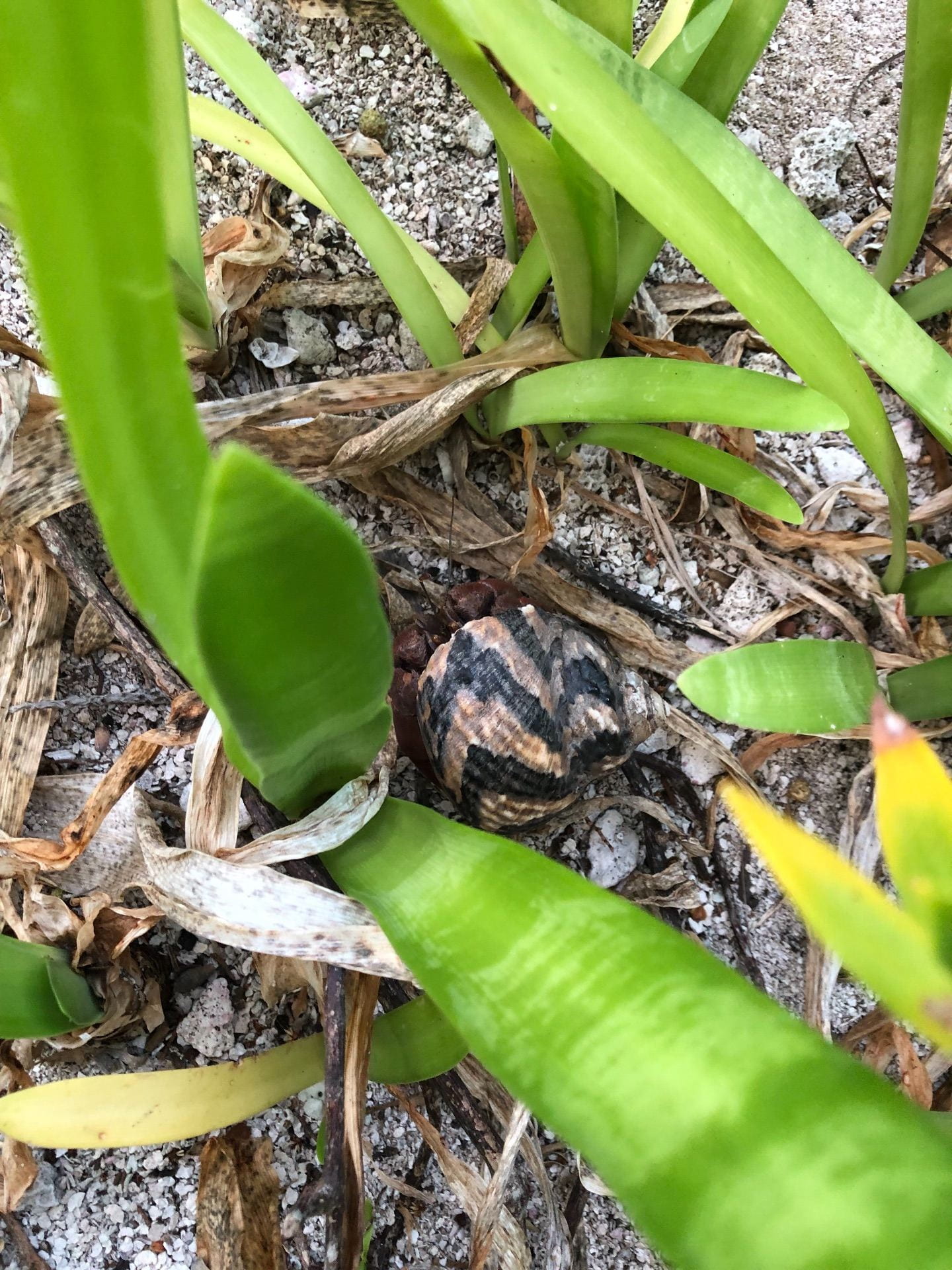
After 6:00am breakfast at the Tropical Education Center, the class drove an hour and half to the marina, then three hours (in a boat) to Middle Caye in Glover’s Reef. The three-hour boat ride was quite exciting because of the high winds and choppy waves—it felt like a roller coaster. Every time the boat ascended a wave, my body would fly out of my seat; then, when the boat crashed back down into the water, my body would smack against the seat. Arriving at the research station was exciting! The view is beautiful up above and all around, and on the ground there are adorable hermit crabs scuttling about everywhere. One of the more interesting hermit crabs that I observed had a snake-like pattern on its shell with banding and scale-like coloration.
Hermit crab with snake-like shell
We tried our gear out in the ocean for the first time. While circling the patch reef, I saw several yellowtail snappers (piscivorous fish!) I also saw an upside down jellyfish and a sting ray hidden in the sea grass. The class migrated to the leeward side of the island in the hopes that the wind and currents wouldn’t be as overwhelming. To reach the leeward side, we had to run through the ‘mangroves of death’. Today, we truly experienced what the ‘mangroves of death’ mean. As soon as we reached the area, Scott took off running with little warning. We were confused, then we started feeling the bites. At one point, I had 7 mosquitoes attached to my body. These pests were swarming all over and biting through the dive skin. I have bumps all over my legs, arms, and face, and my skin feels like Braille. I don’t know Braille very well, but I believe that my right arm spells O U C H. My skin is red, blotchy, and very, very angry at the mangroves of death. We made it to the other side of the island though, and I saw fire coral, Christmas tree worms, what I believe are young grunts, and a slippery dick (Halichoeres bivittatus).
Unfortunately the only path back to the research station was through the mangroves of death. We were aware of the danger this time, but it turns out that not even speed, mad flailing, and slapping can save us from the mosquitoes. Back in my room, I saw a common house gecko crawling on the ceiling above my bed. He was unusually large—at least 15cm in length and 3cm in width (very, very fat). I spooked him and he fell from above the top bunk to the floor with a thud.
The class ended the night with lectures on corals, sponges, and reef microbes.
T minus 12 hours until I’m on a plane to Belize! Will this trip be the academic experience of a lifetime? Will this trip re-define my perspective of the world? Will my poor sight hinder my ability to distinguish between a snake and a branch leading to a rather tragic and short-lived trip for me? All this remains to be answered in the upcoming weeks.
It’s May 13th. My stuff: packed. My assignments: turned in. I am: excited. Now that I’ve established myself as ‘that one kid who feels an obligation to title ever blog post with a horrible pun’, I have to say: I am beyond excited to meet everybody, bond, learn, and experience the wonders of Belize. I hope to come away with valuable field work experience and skills that I can bring back with me to Vanderbilt labs (plus 10 new friends)!
While the obvious anxieties for a newbie to the tropics arise (heat, diarrhea, getting lost), it is my habit as an overachiever to worry more about my grades. Fingers crossed, the readings will sufficiently prepare me for conducting quality research. As an off-campus class member, I know that my preparation process has been slightly different from the rest of the class body. Communication has been a source of annoyance, but those woes are soon to be gone once I am integrated into the class. I packed my gear and living supplies into two bags and flew down from the 901 to Houston yesterday, where I have been crashing on my cousin’s couch and eagerly awaiting Belize (picture of me experiencing Houston attached below). Here’s to an awesome experience! See y’all soon!
In the morning we worked on lion fish dissections. Unfortunately Sami and I were only able to dissect the smaller lion fish, so while dissecting the lion fish, we were unable to identify the sex of ability to spawn. The organs were too small to be identified. However, we were able to see that one of the lion fish we dissected had a small inside! The fish was only partially digested so we were able to identify some of the body parts. I learned in Jessica’s lecture on invasive species that the native fish do not recognize lion fish as predators, so it was sad to see the digested fish inside its stomach. I never actually got to see the lion fish while they were alive, so as I saw Scott use the tongs to carefully remove its venomous anal, pectoral, and dorsal spines, I was wondering how intimidating the lion fish would have looked with it’s spines. Although lion-fish in the Caribbean have caused awful effects as invasive species in removing native fish species, I think their warning coloration are visually captivating- the brown lines around their head and body are incredibly detailed, and their venomous spines are quite scary. One of my favourite parts of the dissecting has to be consuming the fish- Scott made a mean ceviche.
In the afternoon I went on an optional snorkel. A couple of us snorkeled to the nearby patch reef, moving from one place to another. I got to see a few squirrel fish exhibiting their usual behaviour- swimming away from me, hiding in rock crevices, and erecting their dorsal spines when I got too close. While swimming back, I got to see a sting ray! For some reason it was exhibiting really interesting behaviour- it was fluttering it’s body (non-propelling but undulating locomotion). It clearly wasn’t moving to swim, and it was just causing a disturbance in the sediments on the benthos. Perhaps it was hunting or practicing some other type of behaviour. The sediments the sting ray was raising from the benthos made it difficult to identify its shape and colour, so I can’t decide if it’s a southern stingray because I only got a glimpse of its yellow-beige coloured back.
To end the day perfectly, we got on a boat and headed to Marisol on Southwest Cage. We ordered our drinks and had them by the docks overlooking the shoreline of the island and I ate some conch ceviche. Conch ceviche with chips was probably my favourite thing I’ve eaten all trip. Later Rose taught us to dance in the Belizean way, and we had an amazing time trying and failing to imitate Rose. Once we got back on Middle Caye, we watched the beautiful sunset on the dock and lowered diving lights once it got completely dark.
After waking up in the morning to thunder, rain and winds, we finished the lectures instead of going into the water. I was relieved to give the last lecture on mangroves, seagrass, and coral. Afterwards we went to the coral graveyard to pick up trash for our experiment, Talk Dirty To Me, where we wanted to figure out trash composition and amount on the windward and leeward side of Middle Caye. We also went to the mangroves where my face was butchered by mosquitos. I got a bite above my eyelid which later swelled up, so I had a little difficulty opening my right eye in the afternoon. I also got two bites on my forehead. Those mangrove mosquitos are absolutely awful.
We then finally went out to the reef at 2:05, only 5 minutes later than the time we were supposed to leave. Yay! I had an absolute blast swimming in the “aquarium”, the deeper reef off North-west Caye and a channel off Long Caye this afternoon. I was able to find so many different types of piscivorous fish, and I was so happy. I got to swim right next to a trumpet fish off Long Caye, along with a school of Yellow tail snappers. I also saw two sting rays, which was probably a yellow stingray and a southern stingray. I dived to look for lionfish in the crevices of the rocks and at the bottom of the corals, but I just ended up finding dozens of Squirrel fish. I think the squirrel fish I saw were Holocentrus. We also saw two nurse sharks. Unfortunately, one of the nurse sharks we saw had a fishing line and a plastic bottle around its fin, and we couldn’t remove it because we couldn’t risk being attacked.
When I got on the boat from the last snorkel, I heard Scott saying that he saw a black tipped reef shark and a spotted eagle ray. I WAS SO SAD AND MAD I DIDN’T GET TO SEE THEM. I love sharks, so I was really sad that I didn’t get to see the black tipped reef shark. The spotted eagle ray is also such an iconic fish, so I was also sad that I missed out. I hope I get to see it before I leave here!
For the first time we didn’t go out on the boat to snorkel because we worked on our poster this morning for our sea urchin and hard coral project. Since we all can’t work on the poster at once because space is limited, I fell asleep on the hammock. I took around 3 short naps, which was great. I worked on the title, writing “MP-Yay for Reefs” and later we presented the poster to Scott.
After lunch we completed some of our lecture topics, and we left to go to the shallow sea grass bed. It was really hot from the sun, so the mangrove soil was just mushy, warm and disgusting. However, after walking deeper into the seagrass bed and seeing all the conches, sea anemones, and sea snails, I got very excited. I finally swam past the sea grass where I saw a nurse shark! It was swimming away from me, but I still got to see it for a few seconds before it swam away.
I swam into the corals and I was so happy. The water had cooled down to a more comfortable temperature and I picked up a few crabs, a few brittle stars, and a sea urchin. I also got to swim with a school of fish, which reminded me of the opening scene of Lilo and Stich. I was lost track of time and where I was, and I felt so calm snorkeling among all the fish around me. I realized that I loved the ocean a lot, and I regretted not bringing my camera with me to document this moment. Even though I didn’t take any pictures, I still had a blast swimming through coral, admiring the biodiversity around me, and looking between corals for creatures- in fact, I saw a gigantic lobster. I only got to see its head, but it was about 60 cm long. While swimming back to Glover’s, we saw another nurse shark. It was way smaller at around 40 cm long and I only saw it swimming away from me. It swam underneath Veronica!
After dinner we were sitting by the docks looking at the sunset, and while walking to the end of the docks, Scott found a barracuda! It was around 70cm long, and it was slowly swimming under the docks and it didn’t seem like it was hunting. We also saw two southern sting rays swimming underneath us in the docks as well. I only got to see them when they were swimming away from us. Even though all the piscivorous fish I saw today were swimming away from me and only got to see them for a few seconds, I’m still glad I got to see them.
We went out to the fore reef this morning. We got on the boat and went outside the reef crest, and the current was pretty strong. The waves were making it difficult to swim, but Scott and Javier said that the conditions were surprisingly tame. I now understand the importance of atolls and corals on wave movements. I was exhausted swimming and keeping up with everyone, but I got to see a yellow tail sting ray before it quickly swam away.
In the afternoon we went out to the reef to collect sea urchins! At first, I was scared of getting their spines in me because I’ve seen my friend get a spine stuck in his foot, and it looked painful. I found so many sea urchins but I only used the tongs to pick them up. I got to put them in my hand while counting the urchins and measuring their length. We then moved outside the Marine Protected Area (MPA) to collect urchins and I got more comfortable picking the urchins up, so I got a few with my hands. They were so cute and didn’t stab my hand except my thumb got scraped up. I used the tongs to catch the Diodema Antillarium, which was absolutely ginormous compared to the others. I had no idea that their spines are venomous so I’m glad I used the tongs. While swimming in the afternoon, I managed to get hurt by a fire coral though. While navigating my way through the coral, I made a sharp turn and the small patch of skin on my ankle that wasn’t covered by my water booties or lycra dive skin hit the fire coral. I was glad that it was only a small patch of skin and how much better my ankle felt after Javier, the water safety officer, poured vinegar over my ankle.
At night we finally got to do our dermit (hermit crab derby) race. I cheated and caught a Caribbean blue crab instead of a hermit crab. I named mine Rihanna. Rihanna was very feisty and had a hard time not attacking me and staying on the race course. She ended up trying to climb the wall of the dining area in the second heat and eventually escaping, ultimately disqualifying her. She’s still a winner in my heart though.
We woke up for a 7 o’clock breakfast, which is the latest breakfast we’ve had this week (bless this island). We then learned how to use the quadrat in the morning by measuring leaf matter. We finally moved into the seagrass bed and counted worm holes in the ocean. I saw a lot of conch shells, and I regret not picking them up because I thought they were poisonous or they’d sting.
In the afternoon we went to the coral graveyard. (Quick shout out to Adrienne – we miss you) I couldn’t believe how intact and well preserved the corals there were. I was also shocked by the sheer amount of coral as well- the entire area was covered by the fossilized coral. It was very helpful to have the Glover’s Reef guide to help identify the coral fossils.
We then finally got onto the boat and went to a shallow coral reef. Sami and I were fortunate enough to swim through the part of the reef with a lot of coral and fish. We were able to see around 8 sea urchin in one area, and we also got to see a lot of small herbivorous fish. I was able to see a fish that I think is a tiny tiger grouper. It had the characteristic shade of blood-orange with white patterning. It quickly swam underneath some rocks. When I was heading back to the boat, Sami managed to lose our quadrant, which is about a meter by a meter long. Don’t ask me how that happened.
After spending about an hour in the shallow coral reef, we went to a deeper area. This area wasn’t as dense with coral or fish, but I got to see a Spotted Moray Eel! Half of its body was concealed under rocks, which is their typical behavior. The other half was lying on the benthos motionless, but it may have just been swaying with the current.
Then we went back to the island where we had Matthew cut fresh coconuts for us. It was delicious and very refreshing after spending hours under the ocean.
After going on a 3-hour boat ride from the mainland over clear waters and beautiful skies, we finally made it to Glovers!
The island is absolutely breath-takingly beautiful. I have no complaints. Maybe except for the sand flies because they’re surprisingly painful for their size. It was amazing to be able to have a delicious lunch while looking at the picturesque beach and bright blue sky.
When we went snorkeling today for the first time, I may have pulled my right calf because I am still in a lot of pain almost 8 hours later. But before I pulled my calf I learned an important lesson. Five minutes into snorkeling, I had to take my mask off because it was getting very foggy. I just stood on the sea grass bed and proceeded to take my mask off while joking around with Sami. Javier, our water safety officer, soon swam next to me and told me to watch where I stood because there was a yellow sting ray between Sami and I. We quickly learned our lesson. The Yellow stingray wasn’t moving and just kept blinking.
The next piscivorous fish we saw was a baby nurse shark! It was on the bottom of the sea grass bed. It was about 0.7 meters long, which is about a third of their mature length. It was just hanging out on the bottom of the sea grass bed not doing anything. They really do live up to what they are known for – calm and gentle.
I think I pulled my right calf muscle and it hurts to stretch my calf muscle, so until my calf heals I’ll be taking frequent breaks and taking it easy.
Both the tropical rainforest and coral reef ecosystems host a great biodiversity of organisms, which depend upon each ecosystem’s structure for survival. To start off, both ecosystems can be stratified into layers; as a result, some structures in the rainforest and reef will be more exposed to light than others. Varying amounts of light creates different microhabitats, fostering a large biodiversity of organisms adapted to specific niches in each habitat. An array of organisms will also adapt to the habitat’s nutrient availability (dependent on light availability), thus also promoting a large biodiversity of life.
Personally, I have noticed that micro-organisms play a large role in the trophic balance of both ecosystems and that their presence should not be discounted. A lot of human-made environmental stressors are being put on these environments, resulting in activities such as defaunation, deforestation, and coral bleaching. As far as differences go, the rainforest appeared to be more of an enigma; whereas in the coral reefs we would see larger fish such as nurse sharks and sting-rays floating around every now and then, the rainforest offered a lot more cover and megafauna sightings by eye were few and far between. Also, life on the forest floor is different than life on the ocean floor- the forest floor has detritus, fallen tree trunks, and leaf litter which provide perfect habitats for many organisms while the ocean floor’s organismal diversity is not as abundant.
This course completely exceeded my expectations- granted, I did not really know what to expect in the first place. I have never trekked in a rainforest or snorkeled in such close proximity to coral reefs before, so every single day was a sensory overload. On one hand I was trying not to succumb to the waves and crash into reef structures/trip on a hidden root during the steep 50 hectare declines and on the other I was attempting to observe all of the sights, sounds, and smells around me because this expedition is a once-in-a-lifetime opportunity. I truly enjoyed every second of this course and am more confident in my body’s maneuverability because of it.
My favorite parts of the course were hands down the trek to and from the Bird Tower and the lionfish dissection. The steep hike up to the Bird Tower just oozed a serene ambiance- I felt like I was traipsing through a painting, somehow managing not to trip on anything while the evening’s orange rays poked through the canopy. The views from the Bird Tower were breathtaking. To top it off, we all sat and listened to Turiez talk about her research work while munching on Doritos. Classic. The night hike down was even better- there was a point where we quietly stood still under the moonlight and listened to the sounds of the rainforest. That moment really put the size of the rainforest and the size of my body into perspective. The world is so anthropocentric and I feel like I get caught up in human social constructs instead of realizing that other life forms exists outside of the human species. The lionfish dissection was great too- I’ve always loved dissecting animals since middle school and enjoy comparing anatomical similarities between organisms.
Least favorite part- definitely the blue land crabs and moths. They have been so menacing to me the whole trip. However, I would do anything for more blue land crab/moth interactions if it meant being able to stay in Belize for another week.
Is that a leaf? No, it is my greatest enemy.
Despite the time and effort we all put into the lectures, I think the most important lessons from the course came out in the field. No matter how meticulously tailored an experiment is to the rainforest/coral reef, the truth is that these ecosystems are incredibly complex and standardizing a problem with experimental trials and data is tough- there will rarely be a “final answer” to a certain question. I learned to trust my sense of balance a bit more after being battered by waves of salt water and tripped by roots that grab onto your ankles, which can hopefully get me through the concrete jungle of life just fine. Finally, here’s an important tidbit of information I’ll find useful if I go trekking off-trail in the future: off-trail trails made by other people can be identified by bent stems, upside-down leaves, hacked sticks, and various other subtle markers.
Belize was fun and unbelievable. It was funbelizeable (I really hope that pun catches on).